
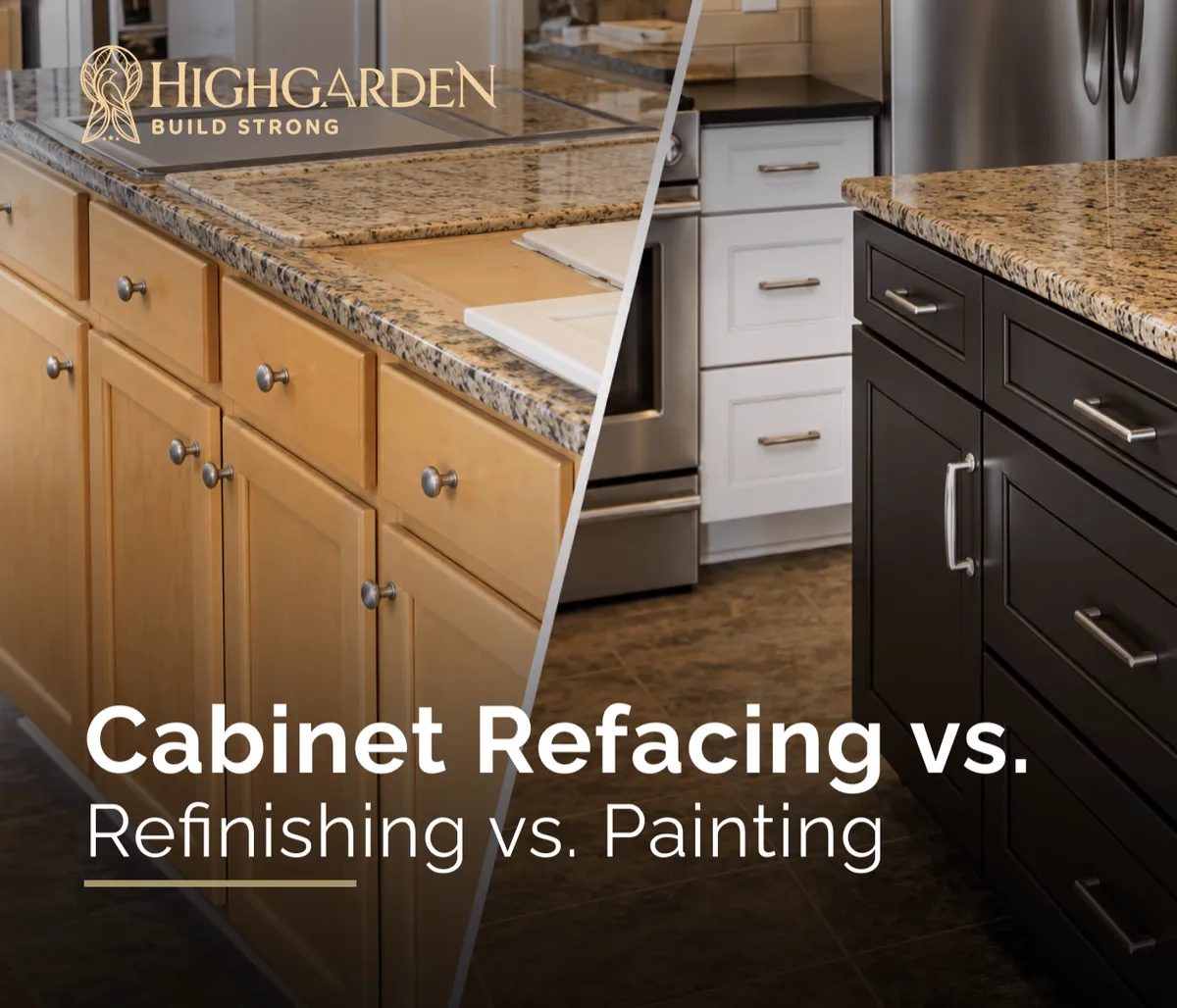
Cabinet Refacing vs. Refinishing vs. Painting (2026)
Your kitchen cabinets are looking outdated, but replacing them completely might not be necessary. If the cabinet boxes are still in good condition, three alternatives deserve consideration: cabinet refacing, cabinet refinishing, and cabinet painting.
At first glance, these methods may seem interchangeable. After all, each can improve the appearance of kitchen cabinets without rebuilding the entire room. But they use different materials, involve different preparation methods, and create different results.
Cabinet refacing replaces doors and drawer fronts and updates visible cabinet-box surfaces. Cabinet refinishing restores or changes the finish on existing components. Cabinet painting applies an opaque color to existing surfaces and is technically one kind of refinishing.
The right method depends on what you want to change about your cabinetry—not simply which estimate is lowest. This guide compares their processes, 2026 pricing, suitable materials, long-term maintenance, and the situations where cabinet replacement makes more sense for homeowners in Newton and Greater Boston.

Cabinet Refacing vs. Refinishing vs. Painting: Quick Comparison
Feature | Cabinet Refacing | Cabinet Refinishing | Cabinet Painting |
|---|---|---|---|
Cabinet boxes | Kept | Kept | Kept |
Original doors | Usually replaced | Retained | Retained |
Drawer fronts | Usually replaced | Retained | Retained |
Primary change | Door style and visible finishes | Existing surface finish | Opaque cabinet color |
Natural wood grain | Possible with suitable finishes | Can be preserved or renewed | Usually concealed |
Changes door style? | Yes | No | No |
Changes kitchen layout? | No | No | No |
Structural repairs included? | Not by default | Not by default | Not by default |
Typical cost level | Higher | Low to moderate, varies by coating | Often lowest for cosmetic updates |
Best for | Outdated door profiles | Worn wood finishes | A new color on sound cabinets |
Terminology matters: Some contractors use refinishing to include painting. To make the options easier to compare, this article uses refinishing mainly for stain or clear-coat restoration and painting for an opaque coating. Always confirm what each proposal includes.
What Is Cabinet Refacing?
Cabinet refacing keeps the existing cabinet boxes but replaces the doors and drawer fronts and updates exposed cabinet surfaces. Depending on the system, the installer may apply matching wood veneer, laminate, or another compatible finish to face frames, end panels, and visible areas. Hinges and handles can also be updated.
Imagine a kitchen with strong oak cabinet boxes but ornate raised-panel doors. If the homeowner wants flat-panel or Shaker doors, painting alone cannot change the profile. Refacing makes that style change possible without removing sound cabinet boxes.

Advantages of Cabinet Refacing
Offers different door profiles, including Shaker, slab, and selected traditional styles.
Reuses structurally sound cabinet boxes and can reduce demolition.
Can coordinate replacement doors with new visible frame and panel finishes.
May allow existing countertops and surrounding finishes to remain.
Can incorporate new hinges, hardware, and optional accessories.
Limitations of Cabinet Refacing
Refacing does not solve a failing cabinet structure or fundamentally change the layout. Most cabinet interiors remain as they are. Deteriorating boxes, major moisture damage, unstable construction, or inadequate storage may make replacement more appropriate.
Best choice when: You like the layout and storage, but dislike the door design or visible cabinet finishes.
For more detail on the process, read the related Cabinet Refacing Guide once that article's published URL is available.
What Is Cabinet Refinishing?
Cabinet refinishing renews the existing cabinet finish while keeping the original doors, drawer fronts, and cabinet boxes. A wood-finishing project may include cleaning, suitable preparation, removing or treating older coatings, repairing minor surface issues, staining, and applying a compatible protective finish.
For example, natural oak or maple cabinet doors may have an attractive profile but a faded or uneven finish. Refinishing can preserve the look of the wood rather than replacing the doors with new ones.

Advantages of Cabinet Refinishing
Preserves existing cabinet doors and craftsmanship.
May restore or alter the appearance of natural wood grain.
Can cost less than purchasing and fitting replacement doors.
Reduces the need to discard usable cabinet components.
Limitations of Cabinet Refinishing
Refinishing cannot change raised-panel doors into Shaker doors, and not every material accepts a new stain or coating. Thin veneer can be damaged by excessive sanding; MDF and laminate cannot simply be stained to resemble natural solid wood. Prior coatings, repairs, and wood species can also affect the result.
Best choice when: You like the existing door design and wood grain but want to renew or adjust its finish.
What Is Cabinet Painting?
Cabinet painting applies an opaque new coating to existing doors, drawer fronts, cabinet frames, and suitable exposed surfaces. It is technically a type of refinishing, but its primary goal is typically to change color rather than showcase natural wood grain.
Professional work usually involves checking the substrate, cleaning grease and residue, preparing existing coatings, priming where required, applying a cabinet-compatible finish, and following manufacturer drying and curing requirements.
A homeowner may turn dark cabinets warm white, navy, taupe, or muted green while keeping their original door profiles and cabinet layout.

Advantages of Cabinet Painting
Often the least expensive way to make a noticeable cosmetic change.
Provides a broad choice of opaque colors.
Retains existing doors and cabinet components.
Can coordinate with adjacent wall, trim, and interior painting work.
Limitations of Cabinet Painting
Painting does not change the shape of the doors, increase cabinet storage, or repair failing boxes. Wood grain or deep surface defects may remain visible depending on preparation and finish. Poor preparation or incompatible materials can lead to chipping, peeling, or adhesion problems.
Best choice when: Your cabinets and doors are sound, you like their design, and your main goal is a different color.
Cabinet Refacing vs. Refinishing vs. Painting: Cost Comparison in 2026
Published national prices can help establish a rough budget, but they are not local contractor quotes or estimates for identical kitchen sizes.
Angi's 2026 national cabinet resurfacing guide provides the following broad project ranges:
Cabinet Update | Published U.S. Cost Range | Main Cost Drivers |
|---|---|---|
Cabinet painting | $180–$3,200 | Cabinet count, surface preparation, coating, labor |
Cabinet refinishing | $2,000–$7,000 | Finish removal/preparation, wood condition, stain and topcoat |
Cabinet refacing | $4,000–$13,500 | Doors, drawer fronts, veneer/laminate, hardware, installation |
Source: Angi's national cost guide. Ranges reflect different project sizes and scopes; some lower painting figures represent small jobs. Refinishing terminology and inclusions can vary by provider.
Why Painting Is Often Cheaper
Cabinet painting usually retains the original doors and boxes, requiring fewer new manufactured components. It can still involve significant labor for grease removal, surface preparation, masking, priming, and applying a suitable finish.
Why Refinishing Can Cost More Than Painting
Restoring natural wood may require more extensive finish preparation and careful stain or clear-coat application. Color matching can be challenging, particularly if wood species, age, or previous coatings differ between doors.
Why Refacing Often Costs More
The project requires new doors and drawer fronts plus materials to cover the visible cabinet boxes. Measuring, ordering, custom dimensions, edge finishing, hardware, and installation add costs that painting generally does not have.
Does the Cheapest Method Deliver the Best Value?
Not necessarily. If the door style is what you dislike, inexpensive painting may still leave you dissatisfied. Conversely, purchasing replacement doors is unnecessary if you already like them and only want a color change.
The sensible approach is to select the least extensive method that actually solves the problem. For a dedicated price breakdown, add an internal link to Cabinet Refacing Cost after that article is published.
Which Method Works Best for Your Cabinet Material?
Before choosing a method, identify the substrate. Solid wood, wood veneer, MDF, laminate, and thermofoil require different preparation and have different limitations.
Cabinet Material | Painting | Stain or Clear Refinishing | Refacing |
|---|---|---|---|
Solid wood | Often suitable with proper preparation | Often suitable | Possible if boxes are sound |
Wood veneer | May be suitable | Limited by veneer thickness and coating | Possible if construction is sound |
MDF | Often suitable with appropriate primer | Not for exposed natural wood grain | Possible when substrate is stable |
Laminate | Requires a compatible coating system | Not conventional wood staining | Depends on substrate and adhesion |
Thermofoil | Product-specific; may be unsuitable | Not conventional wood staining | Evaluate substrate and surface condition first |
Suitability depends on the exact cabinet construction, existing finish, moisture exposure, and manufacturer specifications. The table is not an installation warranty.
Solid Wood Cabinets
Solid wood can often be stained, clear-coated, or painted, provided the existing finish and wood condition are appropriate. Its grain, previous repairs, and natural movement still affect the final result.
Wood Veneer Cabinets
Wood veneer has a thin wood surface; aggressive sanding can penetrate it. A coating or refinishing approach needs to reflect veneer thickness and the existing adhesive and substrate.
MDF Cabinets
MDF is commonly used for painted components but is sensitive to swelling from moisture. Damaged edges or water-affected panels may require replacement rather than cosmetic work.
Laminate and Thermofoil Cabinets
These are not natural wood surfaces. Some can be painted with product-specific preparation, but poor adhesion, heat damage, delamination, or a compromised substrate can make a finish update impractical.
Which Option Produces the Biggest Visual Transformation?
The most dramatic-looking option is not automatically the most appropriate. Match the method to what is outdated.

If the Problem Is Cabinet Color
If your Shaker doors are in good condition but the finish is too dark, painting may be enough to create a light, modern look while preserving the original door design.
Explore first: Cabinet painting.
If the Problem Is Worn Natural Wood
If attractive oak doors have faded or discolored, an appropriate wood-finishing process may restore the appearance while keeping the natural grain visible.
Explore first: Cabinet refinishing.
If the Problem Is the Door Profile
If the cabinet doors are ornate and you prefer simpler fronts, applying new paint will not remove the raised-panel shape. Refacing with new doors may be the better solution.
Explore first: Cabinet refacing.
If the Problem Is Storage or Layout
If your kitchen needs wider drawers, more pantry space, better appliance clearances, or replacement of damaged cabinetry, none of the three cosmetic approaches resolves the fundamental issue.
Explore first: Cabinet replacement or complete kitchen remodeling.
These are hypothetical scenarios, not documented HighGarden Builder renovation results.

Which Cabinet Update Lasts the Longest?
There is no universal winner. Durability depends on the cabinet's original condition, selected materials, surface preparation, installation, moisture control, and maintenance.
Painted Cabinet Durability
Cabinet coatings must tolerate frequent hand contact, household cleaning, and kitchen conditions. Cleaning grease, selecting a compatible primer and coating, and respecting curing time are essential to performance.
Refinished Cabinet Durability
Wood finishes differ in repairability and maintenance needs. Prior coatings, stain compatibility, and a suitable protective topcoat affect the result. Follow the manufacturer's care instructions.
Refaced Cabinet Durability
The original boxes remain in service. New doors and veneers cannot make damaged boxes sound. Pay particular attention to edge treatment, adhesive suitability, surface preparation, hardware alignment, and manufacturer warranties.
Bottom line: An appropriate product installed correctly on a suitable substrate matters more than a blanket claim that one method is always the most durable.
Which Method Causes the Least Kitchen Disruption?
Painting generally involves preparation, masking, removing or protecting hardware, applying coatings, and allowing drying and curing time. Refinishing can require additional surface treatment, particularly with stained or clear-coated wood. Refacing may have a shorter period of on-site installation after new doors and finishes have been manufactured, but measuring and lead times add to the overall schedule.
When obtaining a quote, separate these phases:
Consultation and cabinet assessment.
Material ordering and manufacturing.
Days of active work inside the kitchen.
Drying, curing, and return-to-use instructions.
Time for unexpected repairs or additional work.
A project with fewer on-site installation days is not necessarily completed sooner from the date of approval.
Seven Mistakes to Avoid When Updating Kitchen Cabinets
1. Painting Over Grease or Failing Coatings
Kitchen cabinet surfaces collect oils and cleaning residue. Preparation must suit the substrate and product; otherwise, the new coating may fail prematurely.
2. Assuming All Cabinets Can Be Sanded and Stained
Veneer, MDF, laminate, thermofoil, and solid wood cannot be handled identically. The wrong removal or sanding technique can damage the cabinet surface.
3. Refacing Cabinets With Structural Problems
New doors cannot repair swelling, loose joints, or failing cabinet boxes. Identify underlying moisture and structural problems first.
4. Choosing a Method That Cannot Change Door Style
Painting and refinishing do not transform ornate raised-panel doors into flat-panel or Shaker fronts. Be clear about the appearance you actually want.
5. Ignoring Countertops and Flooring
The finish should work with materials staying in the room. View samples beside your countertops, tile, and floors in natural and artificial light.
6. Comparing Quotes With Different Inclusions
One quote may include repairs, door removal, hardware, multiple finish coats, and curing. Another may not. Refacing bids may omit organizers or drawer boxes. Compare written scopes.
7. Overlooking Lead-Safe Requirements
In older homes, disturbing painted surfaces may create lead hazards. Assess relevant Massachusetts requirements before sanding, scraping, or demolition.
Cabinet Updates in Older Massachusetts Homes
Newton, Wellesley, Needham, Brookline, and surrounding Greater Boston communities contain homes from many building periods. Original wood cabinetry, detailed trim, earlier repairs, uneven floors, or prior coating layers can complicate even a cosmetic cabinet update.
Preserving Existing Woodwork
If existing cabinets feature attractive natural wood and good construction, refinishing may preserve their character. Painting changes the visual character by covering the grain, while refacing may be appropriate when the boxes are sound but the doors feel outdated.
Assessing Previous Renovations
Cabinet boxes may have multiple coats of paint, different replacement fronts, or past repairs. The finish and underlying materials need to be evaluated before selecting a new system.
Massachusetts Lead-Safe Renovation Requirements
Homes built before 1978 may contain lead-based paint. Massachusetts regulations can require lead-safe renovation contractors and specific procedures for covered paid work disturbing painted surfaces. The Massachusetts homeowner lead-safe renovation guidance explains the applicable conditions, including an interior threshold of more than six square feet of disturbed painted surface per room for covered work. Confirm the rules for the specific property and scope before starting.
Paint, Refinish, Reface, or Replace? A Simple Decision Guide
Question 1: Are the boxes and doors structurally sound? If not, have repairs or replacement evaluated before cosmetic work.
Question 2: Do you like the door design? If yes, painting or refinishing may be enough. If no, consider refacing or replacement.
Question 3: Do you want opaque color or visible wood grain? An opaque color usually points toward painting; a natural wood appearance suggests suitable wood refinishing or new wood doors.
Question 4: Does the layout provide adequate storage and circulation? If not, replacement or kitchen remodeling may provide more useful improvements.
Question 5: Does the estimated cost justify retaining the cabinets? Compare the full result, material quality, cabinet condition, and expected functionality—not just headline prices.
When Complete Cabinet Replacement Makes More Sense
All three approaches depend on keeping existing cabinetry. Cabinet replacement may be the stronger option when:
Cabinet boxes have extensive water or structural damage.
Existing storage is inadequate or poorly configured.
Cabinet dimensions do not fit the household's needs.
Appliances or kitchen work zones must be repositioned.
Cabinet interiors are badly deteriorated.
Extensive repairs and cosmetic work approach the cost of suitable new cabinetry.
New cabinetry can accommodate larger drawers, pantry units, different dimensions, and coordinated layout changes. For these projects, cabinetry should be planned as part of the complete room.
Planning a Kitchen Cabinet Update With HighGarden Builder
HighGarden Builder works with homeowners throughout Newton and Greater Boston on residential painting, cabinet installation, complete kitchen remodeling, finish carpentry, and coordinated interior improvements.
The right scope depends on the existing kitchen and the problems homeowners want to solve. Some spaces primarily need a new color; others would benefit from new cabinetry, storage improvements, or a more comprehensive kitchen transformation.
Explore HighGarden's painting services, cabinet installation services, or complete kitchen remodeling.
Specialized cabinet refacing or wood refinishing should be confirmed during consultation; this article does not imply those are separately advertised HighGarden services.
Frequently Asked Questions
Is cabinet refinishing the same as painting?
Not exactly. Refinishing is a broader term for renewing an existing finish and can include paint, stain, or clear coating. Painting specifically means applying an opaque color.
Is cabinet refacing better than painting?
Refacing is more suitable when you want a different door profile; painting is often appropriate when you're satisfied with the existing design and want a new color.
Is it cheaper to paint or reface kitchen cabinets?
Painting is usually less expensive because it retains the original doors and drawer fronts. Refacing involves new components and finishing materials.
Can you paint cabinets instead of refacing them?
Yes, provided the existing surfaces are sound and compatible with a suitable coating system. Painting does not change door shape or cabinet configuration.
Can you refinish painted cabinets to look like natural wood?
Sometimes, if the underlying material is stainable wood and existing coatings can be removed appropriately. MDF, laminate, and badly damaged veneer cannot simply be treated like solid wood.
Can laminate cabinets be painted?
Some laminate surfaces can accept compatible paint systems after specialized preparation. Product compatibility and the condition of the surface are essential; not all laminate or thermofoil products are suitable.
Does cabinet refacing include painting?
Not necessarily. Refacing ordinarily replaces doors and drawer fronts and updates visible cabinet-box surfaces. Painted finishes may be among the available options, but the scope depends on the installer and materials.
Which option is best for oak cabinets?
Refinishing can preserve oak grain, painting can change its color while keeping the door profile, and refacing can introduce different door designs. Cabinet condition and desired appearance determine the best fit.
What if the existing cabinet finish is peeling?
Find the cause before covering it. Moisture, heat, incompatible coatings, poor adhesion, or substrate damage can require repair or replacement rather than a simple new topcoat.
Can countertops stay during these cabinet updates?
Often, yes. Painting, refinishing, and basic refacing usually leave existing boxes in place. Additional project work or existing damage may change what can be safely preserved.
Which update increases home value the most?
There is no guaranteed winner. Cosmetic updates may make sense for sound cabinets, while a failing cabinet system or poorly functioning layout may justify replacement. Financial value depends on the property, costs, and local market.
Final Verdict: Which Cabinet Update Should You Choose?
Choose cabinet painting when you like your existing doors and simply want a different color.
Choose cabinet refinishing when sound woodwork deserves to be restored or its natural finish renewed.
Choose cabinet refacing when the boxes are worth keeping but the door styles and exposed surfaces need a more significant visual change.
Consider cabinet replacement when the construction, storage, or layout no longer meets your needs.
The best kitchen update starts with identifying what can be preserved, what needs to improve, and which method can realistically deliver the result.
Ready to Update Your Kitchen?
HighGarden Builder helps homeowners throughout Newton, Wellesley, Needham, Brookline, and neighboring Greater Boston communities with painting, cabinet installation, and complete kitchen remodeling.
Request a Project Consultation to discuss your project, or call (781) 747-0162.
Editorial note: All photos in this article are illustrative, licensed Unsplash photos and do not depict HighGarden Builder project outcomes. Published cost ranges come from third-party sources and are not quotes from HighGarden Builder. Confirm local pricing, services, and regulatory requirements before commissioning work.
