
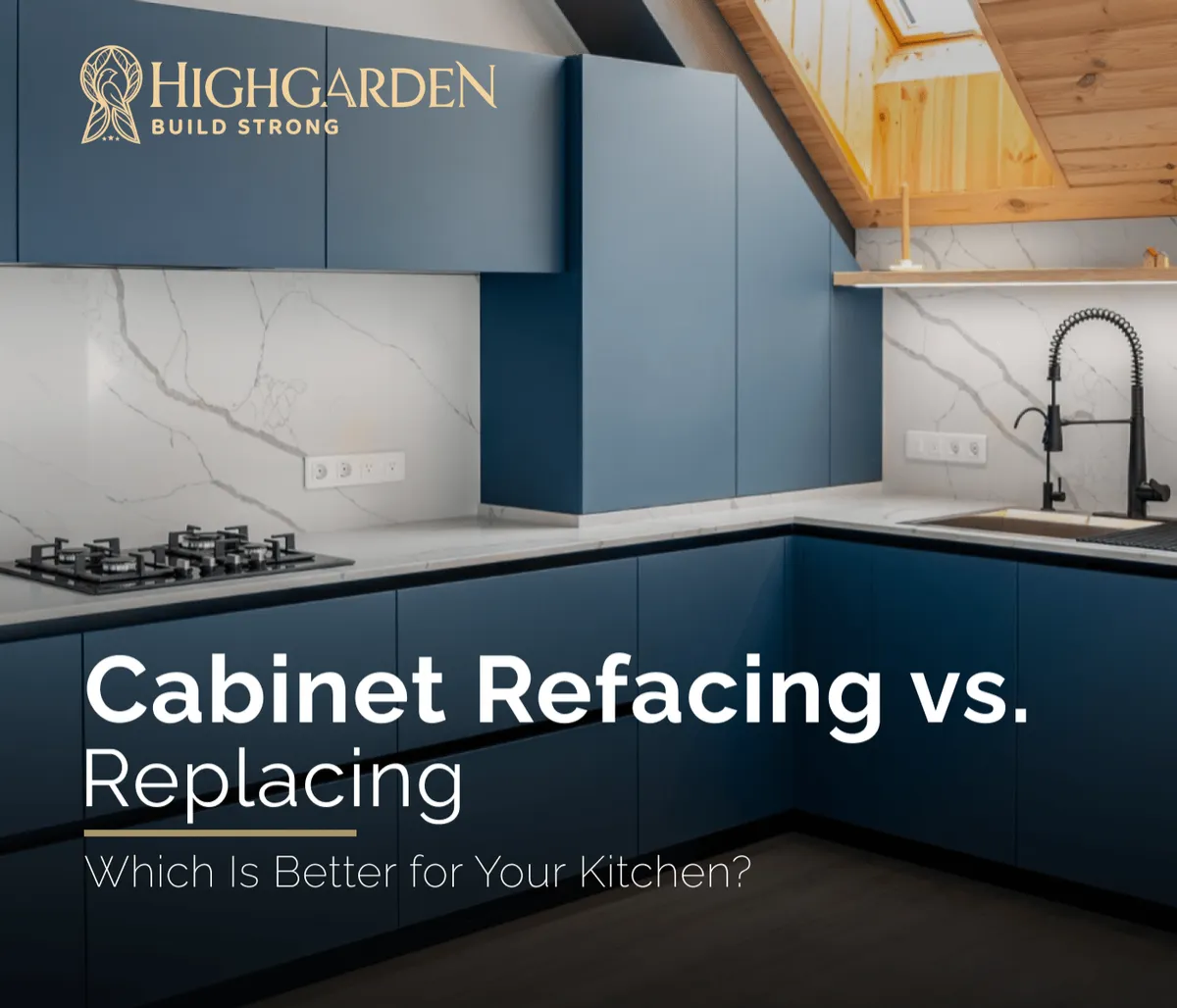
Cabinet Refacing vs. Replacing: Which Is Better for Your Kitchen?
Your kitchen cabinets look outdated, but there's one important question to answer before planning a renovation: Should you reface the cabinets you already have or replace them completely?
Both options can dramatically improve the appearance of your kitchen. But they differ in cost, construction work, design flexibility, and long-term value.
Cabinet refacing keeps the existing cabinet boxes and updates their visible surfaces, doors, and drawer fronts. Cabinet replacement removes the old cabinetry and installs new units, creating opportunities to improve storage, cabinet dimensions, and the overall kitchen layout.
The short answer: Choose cabinet refacing if your cabinets are structurally sound, your current layout works, and you mainly want a new appearance. Choose cabinet replacement if the boxes are damaged, the storage is inadequate, or you want to redesign how your kitchen functions.
But the decision isn't always that simple.
A less expensive refacing project could be the smarter investment for one home, while installing new cabinets could provide significantly better value for another.
Let's compare the options in detail so you can make an informed decision based on your kitchen, budget, and renovation goals.
Cabinet Refacing vs. Replacing: At a Glance
Before examining costs and installation requirements, here's how the two approaches compare.
Feature | Cabinet Refacing | Cabinet Replacement |
|---|---|---|
Existing cabinet boxes | Kept | Removed and replaced |
Cabinet doors | Replaced | New doors with new cabinets |
Drawer fronts | Replaced | New fronts with new cabinets |
Kitchen layout | Generally unchanged | Can be redesigned |
Storage configuration | Mostly retained; some accessories can be added | Greater flexibility |
Style and finish options | Extensive, within existing cabinet constraints | Extensive, including different cabinet sizes |
Structural problems | Does not fix failing boxes | Can resolve damaged cabinetry |
Demolition | Usually limited | More extensive |
Countertop removal | Often avoidable | May be required |
Installation disruption | Generally lower | Generally higher |
Cost | Often lower when existing cabinetry is sound | Varies widely by cabinet type and scope |
Best for | Cosmetic transformation | Functional or structural improvements |
The most important distinction is that refacing changes the appearance of your existing cabinets, while replacement gives you the opportunity to change the cabinets themselves.
That difference affects nearly every other decision.
When Cabinet Refacing Is the Better Choice
Refacing is particularly attractive when you have good-quality cabinet boxes that no longer match your preferred kitchen style.
Think of it as retaining a sound foundation while replacing the most visible elements.
Your Existing Cabinet Boxes Are in Good Condition
The condition of the cabinet boxes is one of the strongest reasons to choose or reject refacing.
Cabinets with sturdy construction, secure joints, reliable mounting, and minimal damage can often be suitable for a new exterior finish and replacement doors.
For example, a homeowner might have solidly constructed cabinets with dated raised-panel doors and an unpopular wood stain.
If the interior storage is functional and the cabinets are structurally sound, removing the entire system may be unnecessary.
However, if the cabinet bottoms are swollen from water damage, the frames are deteriorating, or the cabinets are becoming unstable, refacing may not be a sensible investment.
You're Happy With the Current Layout
Refacing works best when the existing cabinet arrangement already supports the way you use your kitchen.
You don't need to move the refrigerator, relocate the sink, widen walkways, or create entirely new work areas.
Instead, you're primarily trying to improve the kitchen's appearance.
With new Shaker doors, coordinated finishes, and updated hardware, even a traditional kitchen can achieve a noticeably different style without changing its footprint.
You Want Less Construction Disruption
Because the cabinet boxes normally remain in place, refacing often involves less demolition than full replacement.
Existing countertops and some surrounding finishes may also be preserved.
This can make refacing attractive for households that want a visual improvement without a comprehensive kitchen renovation.
However, reduced disruption doesn't mean no disruption. Doors and drawers are removed, surfaces are prepared, and installation work still takes place in the kitchen.
Your Budget Is Focused on Appearance
If your main goals are new door styles, updated hardware, and a more coordinated cabinet finish, refacing may allow you to direct spending toward those visible changes.
The benefit is greatest when you avoid paying to remove and rebuild cabinetry that is still in good condition.
But refacing is not automatically the cheapest solution. Premium new doors, expensive veneers, and multiple accessories can make the price comparable with some replacement options.
When Replacing Kitchen Cabinets Makes More Sense
Cabinet replacement becomes more compelling when your kitchen needs something that new doors and finishes cannot provide.
1. Your Cabinet Boxes Are Structurally Damaged
A new door cannot solve a deteriorating cabinet box.
Common warning signs include sagging cabinet bottoms, significant moisture swelling, unstable joints, damaged frames, or cabinets that are no longer securely attached.
Some isolated damage may be repairable, but a larger pattern of deterioration could justify replacement.
A professional assessment can help determine whether the damage is superficial or affects the cabinetry's structural integrity.
2. The Kitchen Layout Is Inefficient
An inconvenient layout remains inconvenient after refacing.
If you struggle with limited preparation space, awkward appliance placement, narrow walkways, or poorly positioned cabinets, replacement provides greater flexibility.
New cabinetry can support a revised layout with better storage, improved work zones, and more appropriate cabinet dimensions.
For example, replacing a poorly positioned peninsula or redesigning an inefficient corner may solve daily problems that changing cabinet doors cannot address.
3. You Need More Storage
Refacing retains the existing cabinet dimensions.
You can sometimes add pull-out shelves, organizers, or improved hardware, but the available cabinet volume remains largely the same.
Replacement allows you to consider:
Full-height pantry cabinets.
Wider drawer banks.
Deep drawers for cookware.
Better-designed corner storage.
Specialized appliance storage.
More appropriate cabinet heights and depths.
Additional cabinetry where space allows.
If storage is the biggest problem in your kitchen, new cabinetry may provide more meaningful long-term improvements.
4. You Want Better Construction or Interior Components
New cabinet fronts do not automatically improve the cabinet boxes, existing drawer construction, or interior shelving.
If those components are worn or poorly constructed, refacing may leave important issues unresolved.
Cabinet replacement allows you to compare cabinet-box materials, construction methods, drawer systems, shelving, hardware, and other features as one integrated product.
5. You're Already Planning a Complete Kitchen Remodel
If your renovation includes new flooring, countertops, plumbing, lighting, appliances, and layout changes, preserving old cabinetry may create unnecessary limitations.
Replacement can make it easier to coordinate the entire kitchen around the updated design.
For homeowners considering a broader renovation, HighGarden Builder's kitchen remodeling services focus on coordinated kitchen improvements rather than treating cabinetry as an isolated feature.
Cabinet Refacing vs. Replacement Cost in 2026
Cost is often the first factor homeowners compare.
But cabinet refacing and replacement quotes can be difficult to evaluate because the scope of work differs.
According to Angi's 2026 cabinet resurfacing cost guide, cabinet refacing generally costs between $4,000 and $13,500 nationally.
For comparison, HomeGuide's kitchen cabinet pricing guide provides broad installed-cost estimates of approximately $4,500–$15,000 for stock or semi-custom cabinet replacement and $15,000–$30,000 for custom cabinet replacement in an average-sized kitchen.
Option | Published National Cost Reference |
|---|---|
Cabinet refacing | $4,000–$13,500 |
Stock or semi-custom cabinet replacement | $4,500–$15,000 |
Custom cabinet replacement | $15,000–$30,000 |
Sources: Angi's 2026 refacing guide and HomeGuide's previously published replacement pricing. These are broad estimates from different datasets, not prices for identical kitchens or guaranteed 2026 local quotes. HomeGuide's replacement ranges include cabinet materials and installation but may not cover every related renovation expense.
Why Is Cabinet Refacing Often Less Expensive?
A typical refacing project retains the existing cabinet boxes, reducing the need for new cabinet structures, extensive removal, and some related construction work.
It can also avoid disturbing countertops, plumbing, and surrounding finishes when those elements remain compatible with the project.
However, you're still paying for new doors, drawer fronts, materials to cover exposed cabinet surfaces, hardware, and installation labor.
Refacing can therefore represent a substantial investment.
Why Can Cabinet Replacement Sometimes Be Competitive?
Stock cabinets are manufactured in standard sizes and configurations.
Depending on the products selected, their total installed cost may overlap with a premium refacing project.
For example, refacing with expensive custom wood doors and extensive finishing work may cost more than replacing a modest number of cabinets with basic stock units.
That doesn't automatically make replacement better. The construction quality, available storage, project disruption, and cost of surrounding repairs must also be considered.
The best comparison is a pair of written estimates based on the same kitchen and clearly defined specifications.
Don't Forget the Cost of Related Work
Replacing cabinets can introduce additional expenses when existing countertops, backsplashes, flooring, or utilities need to be disturbed.
Ask whether the replacement estimate includes:
Removing and disposing of the existing cabinetry.
Preparing walls and repairing damaged surfaces.
Cabinet installation and leveling.
Necessary plumbing or electrical work.
Countertop removal, reinstallation, or replacement.
Backsplash repair or replacement.
Flooring and baseboard transitions.
Fillers, panels, trim, and finishing work.
Applicable permits and inspections.
Refacing estimates should similarly identify all doors, drawer fronts, exposed cabinet surfaces, repairs, hardware, and installation.
Comparing only the headline prices can create a misleading impression of savings.
Which Option Lasts Longer?
One of the biggest misconceptions about cabinet refacing is that it automatically produces an inferior result to cabinet replacement.
The reality is more nuanced.
Longevity depends on the quality and condition of the cabinetry, the selected materials, the installation, and how the kitchen is maintained.
Refacing retains the original cabinet boxes. If those boxes are well-built and in good condition, they may continue serving the household for years.
However, refacing does not restore the age or structural integrity of the existing boxes.
New doors may look beautiful, but underlying problems such as moisture deterioration, unstable joints, or damaged substrates can still affect the cabinetry's performance.
Replacement provides new cabinet boxes and components, but their quality matters, too.
Replacing sturdy existing cabinetry with poorly constructed new cabinets is not necessarily a durability upgrade.
What About Maintenance?
Both options require care.
Cabinet finishes should be cleaned according to manufacturer recommendations, and water exposure around sinks and cabinet edges should be controlled.
Refaced cabinets with veneer or laminate finishes require particular attention to compatible cleaning products, edge details, and moisture exposure.
New cabinetry also needs suitable installation, adequate ventilation, and proper maintenance.
Rather than relying on a promised lifespan, compare product specifications, construction methods, finish requirements, and warranties.
Cabinet Refacing vs. Replacing: Installation Time and Disruption
Cabinet refacing usually involves less on-site construction than complete replacement.
The Home Depot's cabinet refacing service describes installation periods as short as three to five days for many standard projects.
That refers to installation after materials are ready, not necessarily the entire period from consultation to project completion.
Measuring, ordering, manufacturing, and scheduling can take additional time.
Cabinet replacement timelines vary more significantly.
A straightforward cabinet installation using available stock cabinetry may be relatively efficient, while a larger renovation involving demolition, new utility locations, countertop fabrication, and inspections can require considerably more time.
Project Stage | Refacing | Replacement |
|---|---|---|
Initial assessment | Required | Required |
Ordering or manufacturing | New doors and finishes | New cabinet units |
Demolition | Usually limited | Existing cabinets removed |
Cabinet installation | Existing boxes stay | New boxes installed |
Countertop impact | Often minimal | May require removal or modification |
Utility changes | Usually unnecessary for basic refacing | May be required if layout changes |
Project disruption | Often lower | Depends on scope; potentially substantial |
If minimizing disruption is your main priority, ask contractors for a timeline showing material lead times and actual on-site work separately.
Does Cabinet Replacement Add More Value to Your Home?
A kitchen renovation can influence how attractive and functional a property feels to homeowners and potential buyers.
But spending more money doesn't necessarily produce a proportionally higher return.
A well-maintained kitchen with structurally sound cabinets may benefit from a carefully chosen cosmetic update.
Conversely, a kitchen with poor storage, deteriorating cabinetry, and an inefficient layout may benefit more from comprehensive improvements.
According to the 2026 U.S. Houzz Kitchen Trends Study, 68% of surveyed renovating homeowners who updated their kitchens replaced all cabinets, while 27% chose partial cabinet upgrades.
These figures reflect homeowner renovation choices, not proof that replacement provides a better financial return.
For homeowners planning to sell soon, it may be worth consulting a local real estate professional before committing to a large cabinet replacement project.
For those planning to stay in the home for years, the value of better storage, comfortable circulation, and practical daily use may matter more than immediate resale considerations.
Is Refacing More Environmentally Friendly Than Replacing?
Refacing can reduce demolition waste by retaining serviceable cabinet boxes.
Keeping usable materials in place can also reduce demand for replacement cabinet structures.
But environmental impact depends on more than the amount of material discarded.
New cabinet doors, veneers, laminates, adhesives, finishes, transportation, and manufacturing all have environmental effects.
Cabinet replacement may also involve disposal of existing materials and manufacturing new components.
A practical approach is to preserve usable materials when it makes sense, select durable products, and avoid replacing functional cabinetry unnecessarily.
However, retaining damaged or unsuitable cabinets simply to minimize waste may not be a sound long-term decision.
Can You Replace Only Some Cabinets?
Yes. A complete kitchen cabinet replacement does not always require removing every cabinet.
A partial replacement approach may be possible when specific cabinets are damaged or when additional storage is required.
For example, homeowners might consider replacing damaged lower cabinets while retaining suitable upper cabinets.
Others may add a pantry cabinet or change one section of cabinetry while keeping the remainder of the kitchen intact.
However, partial replacement introduces challenges.
New cabinet dimensions, door styles, finishes, toe kicks, and trim details need to coordinate with existing components.
Countertop support and layout compatibility must also be evaluated.
A hybrid approach can be worth exploring, but it may require more careful planning than either straightforward refacing or complete replacement.
Three Kitchen Scenarios: Which Option Wins?
To make the decision more practical, consider three common homeowner situations.
These are hypothetical examples, not completed HighGarden projects.
Scenario 1: Dated Cabinets in an Otherwise Functional Kitchen
A homeowner has sturdy cabinet boxes, functional drawers, adequate storage, and a kitchen layout that works well.
The main complaints involve dark cabinet finishes and outdated door profiles.
Likely better choice: Cabinet refacing.
Replacing doors and updating visible finishes could deliver the desired appearance without removing sound cabinet structures.
Painting may also be worth evaluating if the original door style is acceptable.
Scenario 2: A Kitchen With Water-Damaged Lower Cabinets
Cabinet bottoms beneath the sink are swollen, several joints are loose, and some shelves have deteriorated.
Although the homeowner likes the existing layout, the cabinet structures need more than a cosmetic improvement.
Likely better choice: Cabinet replacement, at least for the affected sections.
The damage should first be evaluated and the source of moisture corrected.
Refacing the visible surfaces without addressing the underlying problem would not be an appropriate solution.
Scenario 3: A Kitchen That Needs a Better Layout
A family struggles with crowded work areas, limited pantry storage, and an island that blocks movement.
The cabinet boxes are still usable, but their current arrangement makes the kitchen frustrating.
Likely better choice: Cabinet replacement as part of a coordinated remodel.
New cabinetry offers more flexibility to change storage, cabinet sizes, and work zones.
Replacing only the visible cabinet fronts would leave the major problems unresolved.
Cabinet Refacing or Replacement in Newton and Greater Boston
The choice between refacing and replacing cabinets can be especially important in older homes throughout Newton, Wellesley, Needham, Brookline, and surrounding Greater Boston communities.
Many houses have undergone renovations at different points in their history.
An older kitchen may contain well-built cabinet structures worth preserving, or it may have cabinets that were modified or damaged during previous remodeling work.
Each situation requires an individual assessment.
Consider the Original Cabinet Construction
Older cabinetry should not automatically be replaced because of its age.
Some cabinet boxes may feature durable construction and remain suitable for continued use.
Others may contain deteriorating materials, failing joints, or hidden damage.
Inspecting the actual construction is more useful than relying on the installation date alone.
Evaluate Walls, Floors, and Existing Finishes
Uneven walls, irregular floors, and existing trim details can influence cabinet installation.
New cabinets may require careful leveling, fillers, panels, and finish carpentry to integrate with the surrounding room.
If the kitchen has existing hardwood flooring or architectural moldings, consider how each approach affects those materials.
Understand Lead-Safe Renovation Requirements
Massachusetts homes built before 1978 may contain lead-based paint.
Renovation work that disturbs painted surfaces beyond applicable regulatory thresholds can require a licensed lead-safe renovation contractor and specific work practices.
According to the Massachusetts Department of Labor Standards, the requirements depend on the property and the amount of painted surface disturbed.
Lead safety should be addressed during planning rather than after demolition has begun.
Consider the Character of the Home
Cabinet decisions should also complement the property's architecture.
A traditional kitchen may benefit from carefully selected door profiles and finishes that preserve its character.
A more contemporary renovation may require an entirely different cabinet configuration.
The ideal solution is one that improves functionality while creating a consistent relationship between cabinetry, countertops, flooring, walls, and finishing details.
A Practical Checklist: Should You Reface or Replace Your Cabinets?
Before making your decision, evaluate the following questions.
Question | If Yes | If No |
|---|---|---|
Are the cabinet boxes structurally sound? | Refacing may be suitable | Consider repairs or replacement |
Are you satisfied with the kitchen layout? | Refacing remains an option | Replacement may offer more flexibility |
Is existing cabinet storage sufficient? | Retaining boxes may work | Evaluate new cabinetry |
Are the cabinet interiors in good condition? | Refacing may preserve useful components | Compare replacement costs |
Do you primarily want a different appearance? | Refacing may meet your goals | Consider broader renovation options |
Can existing countertops remain? | Refacing may reduce disruption | Compare the full project scope |
Are you planning significant utility or layout changes? | Replacement may be more practical | A focused cabinet update may be enough |
The checklist doesn't replace a professional assessment, but it can help identify which approach deserves closer consideration.
If most of your concerns relate to appearance, explore refacing first. If they relate to layout, storage, or structural condition, compare replacement options.
How to Compare Cabinet Refacing and Replacement Quotes
A good estimate should help you understand exactly what you're buying.
Ask each contractor to provide a written scope and identify the following details.
For cabinet refacing:
Condition of existing cabinet boxes and required repairs.
Number and construction of new doors and drawer fronts.
Materials used to cover face frames and exposed panels.
Hinges, handles, drawer slides, and accessories.
Surface preparation and finishing methods.
Installation labor and project timeline.
Warranty terms and exclusions.
For cabinet replacement:
Cabinet manufacturer, product line, and construction specifications.
Cabinet-box materials and available finish options.
Drawers, shelves, hinges, and other hardware.
Removal and disposal of existing cabinetry.
Necessary wall, floor, and utility work.
Countertop and backsplash implications.
Delivery, installation, and finishing details.
Warranty terms and anticipated lead times.
Most importantly, ensure the quotes cover comparable outcomes.
A refacing estimate that preserves existing countertops and a replacement estimate that includes new countertops, backsplash, and plumbing work are not equivalent projects.
Separating cabinetry costs from other renovation expenses helps make the comparison more meaningful.
How HighGarden Builder Helps With Cabinet and Kitchen Improvements
Choosing the right kitchen upgrade begins with understanding the existing space and what needs to change.
HighGarden Builder provides cabinet installation, kitchen remodeling, finish carpentry, painting, flooring, and coordinated interior improvements throughout Newton and Greater Boston.
For homeowners considering new cabinetry or a broader kitchen transformation, our work includes evaluating cabinet placement, surrounding surfaces, installation requirements, and finishing details.
Whether the goal is more practical storage, an updated kitchen layout, or a cohesive new appearance, it is important to plan cabinetry as part of the overall room.
Explore our cabinet installation services to learn about our installation approach, or visit our kitchen remodeling page if your plans involve multiple improvements.
Frequently Asked Questions
Is it cheaper to reface or replace kitchen cabinets?
Cabinet refacing is often less expensive when the existing cabinet boxes are in good condition and the layout remains unchanged. However, premium refacing projects can overlap in price with stock cabinet replacement. Compare detailed estimates for the same kitchen before deciding.
Is cabinet refacing worth it?
Cabinet refacing can be worthwhile if your cabinet boxes are sturdy, storage is adequate, and you mainly want a different style or finish. It may not be worth the investment if the cabinets are deteriorating or you need significant layout changes.
Can refaced cabinets look like completely new cabinets?
Yes. New doors, drawer fronts, coordinated cabinet-frame finishes, and updated hardware can substantially change their appearance. However, the original cabinet structure and most interior configurations remain.
Can you reface cabinets that are 30 years old?
Possibly. Age alone does not determine whether refacing is appropriate. The cabinet boxes must be structurally sound, properly attached, and suitable for the selected finishing materials. Older cabinets with extensive damage may require replacement.
Does refacing cabinets increase storage space?
Basic refacing does not increase the size of the cabinet boxes. Some interior accessories and upgraded hardware may improve accessibility, but adding significant storage usually requires additional or replacement cabinetry.
Can you keep countertops when replacing kitchen cabinets?
Sometimes, but it depends on the countertop material, installation method, cabinet dimensions, and the condition of the existing surfaces. Removal may risk damaging countertops or backsplashes, so reuse should be evaluated before the work begins.
Is it better to reface or replace cabinets before selling a house?
That depends on the cabinet condition, local housing market, renovation budget, and selling timeline. A focused cosmetic improvement may make sense for sound cabinets, while damaged cabinetry may require more extensive work. Neither option guarantees a particular resale return.
Can you mix refaced and new cabinets in the same kitchen?
Yes, in some situations. New cabinets can sometimes be added or selected units replaced while other cabinets are retained and updated. Matching door profiles, finishes, heights, and trim requires careful planning.
Does cabinet refacing include new drawers?
Usually, refacing includes new drawer fronts, but not necessarily entirely new drawer boxes or slides. Some providers offer those improvements as additional services. Always confirm what is included in the project scope.
What is the difference between replacing cabinet doors and refacing cabinets?
Replacing cabinet doors changes the doors while leaving other visible cabinet surfaces largely untouched. Full refacing typically includes new doors and drawer fronts plus matching finishes applied to the exposed cabinet frames and sides.
How do I know whether my kitchen cabinets are worth keeping?
Check for structural stability, moisture damage, loose joints, deteriorating cabinet interiors, and adequate storage. Then consider whether the kitchen layout meets your needs. An on-site assessment can help determine whether cosmetic improvements are practical.
Final Verdict: Should You Reface or Replace Kitchen Cabinets?
The best cabinet renovation is not necessarily the least expensive or the most extensive.
It's the one that solves the problems in your kitchen without unnecessary work.
Choose cabinet refacing when you have structurally sound cabinets, adequate storage, and a functional layout but want a different appearance.
Choose cabinet replacement when your cabinets are damaged, storage is inadequate, or you need more flexibility to improve how the kitchen functions.
And if the kitchen requires multiple coordinated improvements, consider the cabinetry as part of a complete remodeling plan rather than making the decision in isolation.
Ready to Improve Your Kitchen?
HighGarden Builder helps homeowners throughout Newton, Wellesley, Needham, Brookline, and nearby Greater Boston communities with cabinet installation and kitchen remodeling projects.
Whether you're planning new cabinets, a more functional layout, or a broader kitchen renovation, we can review your project goals and discuss the next steps.
Request a Kitchen Remodeling Consultation
Or call (781) 747-0162 to discuss your project.
